

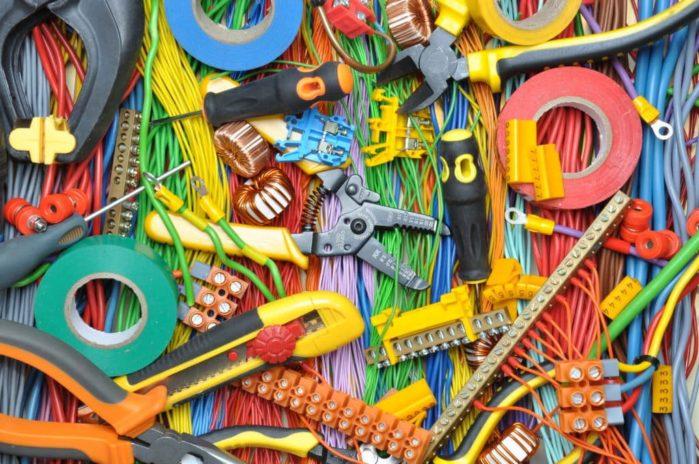
Electrical component kit and cables
Types Of Wire Cutters, Chain Cutters, Pliers & Their Uses
Whether you are a professional carpenter or electrician on the job, a hobbyist with a large project on hand, or just want to have a well-stocked toolbox for when the time calls for it, you are eventually going to need a solid pair of wire rope cutters. Here are some helpful tips to finding the best wire rope cutters for you.

What Are Wire Cutters [Wire Rope Cutters]
Wire cutters are commonly used to cut copper, brass, iron, aluminum, and steel wire. Some wire cutters have insulated handles which ensure that you will not get shocked from the wires you’re working with.
Wire cutters are ideal for a range of electrical based applications, with any wire cutter, you will be to quickly and efficiently cut and maintain wires and cables. The design of the cutter ensures easy use with optimal performance using only one hand and the ratchet mechanism allows for improved leverage.
Wire cutters, chain cutter are also constructed from high quality and corrosion free materials for durability and longevity, and the plastic handles increase comfort during use. The blades of the device can be sharpened and its important to note that this tool should not be used to cut steel wires.
YouTube Video | How I Cut Wire Rope/Cable
Wire Cutter, Wire Rope Cutters Uses
Wire cutters (also called wire rope/aircraft cable cutters) are your essential tools for effective and efficient cutting of wires and metal cabling of varying diameters and are commonly used by engineers in the construction, marine, telecommunications, aerospace, and locomotive industries.
Wire rope cutters, chain cutters are useful equipment to have at home. Whether or not you are the DIY handyman type of person, you can never tell when an emergency can arise. Finding the best chain cutters for you will not only make the job more comfortable, but it can also help you in emergencies!
Jewelers, doctors, electricians, auto mechanics, florists, and even firemen depend on the quality of their wire cutters to deliver professional results. Although most specialized wire cutters have no application in the DIY market, there are nevertheless several types of wire cutters that should be in every handyman’s toolbox.
What Are Common Types Of Wire Cutters / Pliers?
Chain cutters are made in various shapes and sizes and for many uses. Some are used for gripping something round like a pipe or rod, some are used for twisting wires, and others are designed to be used for a combination of tasks including cutting wire. There are also tools that are used just for cutting wires (as opposed to wire cable and rope). Use the correct pliers or wire cutters for the job.
When selecting a wire cutter tool, first consider the type of wire to be cut. Guy Wire, ASCR (Aluminum Conductor Steel-Reinforced cable) or other hard wires. ACSR is a type of high-capacity, high-strength stranded conductor typically used in overhead power lines.
Standard wire cutters are designed for soft copper or aluminum.
- Side cutting (lineman’s) pliers
- Long nose pliers
- Utility pliers
- Diagonal cutting pliers
- Flat nose pliers
- Slip joint pliers
- Groove Joint pliers
- End cutting pliers
Side cutters and diagonal cutters might work for smaller diameter wire rope, but unless the jaws are rated for use on hardened wire or wire rope specifically, this would be a sure way to damage the cutter blades. Cutters designed for cutting copper or even aluminum wires aren’t suitable for cutting even smaller diameter hardened wire.
However, small-gauge wire rope cutters are often limited to diameters 1/8″ or smaller. But when working with harder stranded wire rope or larger diameter rope, such as 3/16″ rope, smaller hand tools might not cut it (both literally and figuratively).
How To Cut Wire Without Wire Cutters?
According to Jason Crossman at quora.com:
Minimal. Wire cutters make it easy but both copper and aluminum are malleable metals. You can cut through standard household wire with a knife or saw, or an axe, or scissors, or a clever or even a hammer and a flat blade screwdriver. If you absolutely need to cut a wire, not that hard. But a pair of side cutters are pretty cheap and readily available.
YouTube Video | Cut Wire Rope Without Cutters
Lists Of Best Bolt Cutters
[amazon table=”12128″]
Lists Of Best Wire Strippers
[amazon table=”8455″]
Lists Of Best Wire Cutters
[amazon box=”B000JNNWQ2,B00FZPDG1K,B06XTVP8BD,B07H3YY9QQ,B00004SBDD,B06X9875Z7,B000A0OW1S,B000NQ4OYO,B000A0S4YO,B07GR7QF63″ template=”horizontal”]
What Should I Avoid Doing?
- Do not cut hardened wire unless the pliers or wire cutters are specifically manufactured for this purpose.
- Do not expose pliers or wire cutters to excessive heat.
- Do not bend stiff wire with light pliers. Needle nose pliers can be damaged by using the tips to bend large wire. Use a sturdier tool.
- Do not use pliers as a hammer.
- Do not hammer on pliers or wire cutters to cut wires or bolts.
- Do not extend the length of handles to gain greater leverage. Use a larger pair of pliers for gripping or a bolt cutter for cutting.
- Do not use cushion grip handles for jobs requiring tools with electrically insulated handles. Cushion grips are for comfort primarily and do not protect against electric shock.
- Do not use pliers on nuts and bolts; use a wrench.
Note: At U.S. Rigging, you shall find many wire cutters, chain cutter, pliers, crimpers, wire strippers, bolt cutters and more.